Category Archives: Newsworthy

A live translation project using Raspberry Pi

Up until now, wearable computing has been confined to some odd bulky wristwatches. Most people are probably aware of the Augmented Reality Glasses, commonly referred to as Google Glass that Google has been working on for quite a while. Google Glass is still in limited release and not available to everyone. So, in the meantime, you can use your Raspberry Pi (RBPi) to fill in the gap. The project has everything you desire – small in size, light in weight and light in power consumption; a cheap lithium-ion battery makes it run for hours.

The project has two RBPi Single Board Computers working as close as possible to the universal translator of the Star Trek fame. The two displays are a pair of digital glasses, quite off-the-shelf. Other standard equipment used are a Jawbone Bluetooth microphone and a Vuzix 1200 Star wearable display. When fully functional, the system uses Microsoft’s publicly accessible API or Applications Programming Interface to perform voice recognition and translation on the fly.

For example, Will Powell, the originator of the project, uses the glasses to have a conversation with Elizabeth, who speaks Spanish. Although Will has never learned Spanish, he is able to converse meaningfully returning the answers in English. Powell’s blog shows a video of the system in action and shows the details of the build.

This project glass inspired translating unit works in real time and displays conversation as subtitles on your glasses. Both RBPi run the Debian squeeze operating system. For using the system, individual users will be wearing the Vuzix 1200 Star glasses, and these are connected to the s-video connector on his RBPi. For a clean and noise cancelled audio feed, Will uses a Jawbone Bluetooth microphone connected to either a smartphone or a tablet.

The Bluetooth microphone picks up the speakers voice and streams it across the network to pass it through Microsoft’s translation API service. For regularly used statements, a caching layer improves the performance. The subtitles face their longest delay when passing through this API service, The RBPi picks up the translated text the server passes back and this is then displayed on the glasses display.

Once a person has spoken, it takes a few seconds of delay before the translation pops-up on the other persons glass display. Moreover, the translations are not always fluid or coherent. However, that has nothing to do with the technology used here; rather it is based on the inaccuracies of the translation API. It is really amazing as to how such a relatively simple setup could offer speech recognition and translation at very near real-time.

At this rate, Augmented Reality Glasses will become popular very soon, and Google has suggested they will make their Glass project commercial very soon. Mobile communication is standing on the brink of a revolutionary technology that Google’s Glass is sure to bring about. However, Powell’s work shows there is still a lot of room to experiment and explore different kinds of functions and applications in this field.

The project also shows that very soon it may not matter what language you speak, anyone will be able to understand you, provided everyone is wearing the right glasses.

Viewing experience redefined for industrial LED displays

LED displays have been on the rise as the latest method for promoting business in all fields. Primeview, US, has taken a big step in this direction through their ECO LINE LED displays. The most interesting part of this development is that it has brought about improvement in a number of features apart from providing all round viewing of 24×7 without a break. ECO LINE LED offers seamless viewing with a 55” super-narrow gap video wall display, with only 3.6 mm thickness from bezel to bezel. This is the slimmest LED display in the world and it is ecofriendly as well.

This display is known as the PRV55SNG indoor LED and it is an industrial display working all 24 hours round the clock and all through the year. The display has a 55” panel and sports the thinnest bezel with the left and top sides measuring 2.35mm and the right and bottom sides measuring 1.25mm in thickness. For realizing such a slim-sized bezel and simultaneously retaining the eco friendliness, the display design is such that it has very few components. The designers have reduced the heat load and at the same time, I/O connectivity access to the board has been improved.

The newly designed PRV55SNG indoor LED display has a number of features. Apart from offering a 500nit brightness panel, the 3.6mm bezel is seamless. It has AC power daisy chaining option and it can be used in either portrait or landscape mode. HDCP compliance is realized with the use of splitters though the PRV main board. The resolution is 1920×1080 FHD. The power consumption is greatly reduced due to the ecofriendly LED backlight. Primeview provides a reliable industrial metal enclosure. Optional HDBASET Rx + embedded Tx are also available for specific clients. This new LED display is being offered with the company’s 3-year warranty not only for the parts but also for the labor.

This product is available for use in almost all areas of business activities, but it can be said to be of more use in Healthcare, Industrial, Broadcast, Hospitality, Digital Signage, Retail business, Higher Education, Corporate, Gaming, and control rooms and many more. The highlight of the display is that it is Eco friendly, scalable and all those who view it will have a new and unbelievable experience. This is significant for the customers as support from Primeview is available for 3 years, which is unheard of in the industry.

This new display panel is being offered for public viewing in the month of April 2014 at the NAB broadcast show being held in Las Vegas. The company has also informed that all those prospective clients interested in private viewing, will have to contact them in advance either over phone or through the company’s website for the necessary arrangements. Significantly, this new development will be of importance as an LED displays in years to come and will be the prime tool for a number of display solutions. Primeval has taken the lead in this respect.

REX – a brain for robots

Not to be confused with Tyrannosaurus the king of beasts, REX is a complete development platform for sophisticated robotic applications. While most robotic designers use the Arduino platform as a base for their robots, Mike Lewis and Kartik Tiwari were not impressed with the available hardware. Their design, REX, is specifically targeted towards robots. REX poses no wiring hassles, has built-in battery inputs and has a robot programming environment that it boots up directly into.

The duo felt people who designed robots needed a new and more advanced platform. When using a single microcontroller for handling multiple sensors, motors and other electronics, problems start arising. The situation worsens as you plan on adding increasingly sophisticated tasks such as speech recognition and computer vision. The Arduino is, by default, not a multitasking platform and is intended for running a single task at a time. However, robotics essentially requires multiple tasks to be running at any given time.

Therefore, REX came up with a 32-bit ARM Cortex-A8 processor core running at 1GHz, an 800 MHz DSP core and 512 MB of RAM. The board runs on the Alphalem Operating System and boasts of a host of features such as built-in drivers for sensors and other similar devices, a task manager to allow launching multiple processes and support for several programming languages such as C, C++ and Python. The Arduino-style programming environment facilitates developing your own robot applications.

REX is a low-cost robot development platform that targets advanced robotics. Although simple robotics can be handled by the Arduino project and is fairly straightforward, REX is geared towards handling the extra functionality required where you need voice recognition and computer vision. Being simple and low-cost, the REX platform helps make more advanced robotics projects more accessible to the average hobby roboticist.

At the core of REX is the ADE or Alphalem Development Environment, consisting of scripts or programs written in C++, which form an Application Programming Interface for communicating with devices connected to REX using the I2C expansion ports. Apart from the built-in drivers that the Alphalem team selected for REX for driving sensors and actuators, the ADE also has a process management system for running multiple programs in parallel for efficient robot control. This, the team claims is the most useful features that REX offers to robotic designers.

Physically, REX is about the size of a standard pack of playing cards, small and compact. This palm-sized, single board computer is priced at $99 for its basic model, which includes the DSP, camera, microphone inputs and preloaded OS. You can use REX to control small simple robots easily.

However, this is not to mean that REX cannot handle complicated stuff. In fact, REX is extremely powerful and is able to handle a huge range of sensors such as speech recognition and machine vision. This allows it to be used for some very complicated robotic activities.

Incidentally, the name for the project was earlier AlphaOne, to commemorate Apple’s first PC. However, Mike, as the product engineer, proposed that the name should be changed to REX since he had a Jurassic Park mug on his desk.

How noise affects touch screens

Although not understood explicitly, touch-screens in devices are susceptible to noise. The offending noise sources may be both internal as well as external. Most common sources of noise affecting touch-screens are display and charger noise. Cheap chargers entering the market are inherently noisy, and this affects the functioning of touch-screens. In addition, as devices get thinner, display noise increases.

In addition, many other items of everyday use generate noise that may cause interference. This includes the AC mains, radio signals and the ballasts used for fluorescent lights. When noise is present, low-performance capacitive touch systems may distort the position reported and this may impact the overall system reliability and accuracy.

Injected noise causes large amounts of jitter (highly variable touch coordinates reported for a stationary finger), false touches reported even for no touch on the screen, non-recognition of a finger actually touching the screen and sometimes a complete lock up of the device. For example, noise may prevent you from being able to unlock your phone, since your finger touch is no longer reported or you dial wrong numbers because of jitter and false-touch reporting.

A user experience of touch interface quality is directly dependent on how well a touch-screen controller combats interference from noise. Poor touch performance when noise is present can make customers unhappy, resulting in an increase in returns. However, since noise may be of different types, touch-screen controllers must be able to detect, differentiate and combat noise, especially the two sources most problematic to users – chargers and displays.

The proliferation of Switch Mode Power Supply or SMPS type chargers has reduced the size, weight and cost of mobile chargers. However, this has also led to the market being flooded with chargers that prioritize cost over performance, using lower grade components and not using certain components that would assist in reducing common-mode noise.

High amplitude, high frequency, common-mode noise emanating from chargers is a major problem resulting in degradation of touch performance of capacitive touch-screen devices. Some manufacturers have addressed this problem of noisy chargers by providing limited functionality when a device is plugged into such a charger. Others may show a message on the screen that the charger is not supported when it is not the approved charger for the device. Online forums reveal customer dissatisfaction of touchscreen performance due to noisy chargers is quite prevalent.

Common-mode noise causes fluctuations of both, the power and ground supplies of the charger voltage, relative to earth ground, but keeping the same voltage differential between them. Such fluctuations affect the performance of the touchscreen only when the finger of the user touches the screen. Since the potential of a finger of the user is roughly the same as that of earth ground, and the charger’s ground and power lines are fluctuating relative to it, the resulting noise enters the touchscreen through the finger.

Manufacturers aggressively pursuing thinner form factors for touch-screen devices has led to displays coupling more noise into the touch-sensors because of their proximity. Earlier, touch-screens had an air-gap or a shield layer for protection. With devices getting thinner, such shields and air-gaps have disappeared and the touch sensor is now laminated directly atop the display.
This increases the capacitance, while the sensor electrodes are closer to the noise producing VCOM layer of the display, increasing the coupling.

Get ready to talk to your gadgets

Google has many things always in the development stages so that they will remain at the forefront of action for internet users and smart phone users. Expectations are high that gadgets in the future will have voice-interface so that users can command different devices verbally. Talking to gadgets will be possible and Google is making sure that it is a part of such breathtaking developments. Smartphones will be the mode for talking to these gadgets and Google is gearing up to provide the necessary tools for the user for home activity from any location. The recent takeover of Nest Labs, which makes smoke detectors and thermostat controllers, by Google at an estimated deal of $3.2 billion, is thought to be precisely for that purpose.

Speaking to kitchen gadgets is likely to become a reality in the near future. The process is known as the “Internet of Things” and is likely to be in the thick of daily routine activities. When launched, it will totally change the nature of human activity at home and will enhance the popularity of the smartphone. According to the research company Gartner, Inc., the Internet is likely to be linked to more than 26 million objects suitable for verbal command and interface. Additionally, connectivity to PC, smartphones and tablets will substantially add to this figure. Tony Fadell is the founder of Nest Labs, and he is an Apple veteran who assisted in designing the iPhone and the iPod.

According to Forrester Research analyst, Frank Gillett, the reason Google bought Nest is “to learn about this world where even more information is going to be accessible by computers.” Nest has already been successful in offering thermostats to users for controlling the cooling and heating of devices at home. Nest, in the last few years, sold their products in the USA, Canada and the UK; it has been well received.

Google has not made any disclosures about the type of activity lined up for Nest for the immediate future. Angela McIntyre, the Gartner analyst, believes that, “They need to gather as much information as they can to understand the context in how we live our lives”, in order to take over all the activities which are routine and have no need for physical presence at home to perform it. It is likely that the mapping software from Google could be utilized to map out the home layout. This will be essential for delegating tasks to a robot if employed at home. It could also lead to navigation of the entire home from a remote place by a smartphone.

Although, at present, it is known that Google’s main source of revenue is from advertising and search requests, there is no doubt that the acquisition of Nest Labs is in the direction of involving with people’s personal activities in a more significant manner without in any way sacrificing their privacy. On the whole, Google could be of assistance with these new tools for people not at home to perform activities through the internet and smart phones even from remote places.

FishPi: How Raspberry Pi controls an autonomous ocean explorer

FishPi is a project for developing the prototype of a sun-powered autonomous ocean-going surface transport controlled by a Raspberry Pi (RBPi). The project is working on a small boat, to be propelled by solar energy to traverse the Atlantic Ocean and during its journey, the boat will be taking pictures and gathering data.

The goal of the FishPi project is simple. They intend to develop FishPis ranging from vessels running on batteries for a few hours to solar powered vessels full of features and capable of sustaining months at sea. The vessels will be MUSV or Marine Unmanned Surface Vessels, which will be capable of crossing the Atlantic ultimately and unaided.

An RBPi unit will provide all the command and control features of the FishPi vessels. The vessel will have an onboard solar panel, and the RBPi will control the data logging, navigation, power management and control of other devices on-board. The solar panel will charge a Lithium-ion battery pack, which will be driving a ducted propeller system. The Amateur Radio Satellite Network will be used to transmit images from the FishPi to the shore, by using satellites to integrate the ship-to-shore communication system.

During its journey, FishPi will use its environmental monitoring and data-gathering capabilities to measure the temperature of the air and sea, salinity and pH, barometric pressure, light levels and more. It will transmit some of the data along with images relayed in real-time.

For this, the RBPi is attached to a 16-channel PWM, a temperature sensor, a compass, a GPS, a USB webcam, a USB Wi-Fi dongle and a RockBLOCK satellite communicator. All these, except the compass and the webcam, are within a box on the FishPi Proof-of-Concept Vehicle or POCV now.

Initially, the base-station was planned to be connected to the POCV with a 32-core cable. However, this became too complicated and caused a lot of interference, so it had to be abandoned. Presently, the base-station contains another RBPi, connected to a USB hub and a 4-port Wi-Fi Router. The Wi-Fi link allows real-time remote control possibilities with the use of xrdp and the FreeRDP client. Additionally, this allows live video streaming to the world over the internet.

The electronic speed controller, the webcam, rudder, temperature sensor, the GPS and the compass are integrated with the C&CS or Command & Control System of the POCV. Currently, the coding is for manual control only, and the POCV can move forward, backward, to the left and to the right. With the webcam as a visual guide, the POCV can be driven remotely, but so far, this has been tested only indoors.

In the future, this control will be automated to the extent of giving the POCV the command and leaving it to navigate itself. For tracking, routing and waypoints, GPX files are being used while GeoTiff file formats are being used for the maps. Telemetry is an important function for any ocean-going vehicle. The POCV will be communicating both ways via the RockBLOCK Satellite Communication link.

There is always a chance that the vehicle can capsize in rough seas, and therefore, next in line is a self-righting mechanism.

Magneto resistive random access technology (MRAM) for better memory storage

Technologists researching at the laboratories of the National University of Singapore in the department of Electrical and Computer Engineering have developed a new technology that will help in enhancing storing information in electronic systems in a better and more durable manner. Called Magneto Resistive Random Access Technology, this innovative method increases the storage space considerably and ensures that all fresh data will remain intact, even when there is a power failure. The team of researchers, led by Dr. Yang Hyunsoo, has filed for a provisional patent in the USA. They claim that the development will bring about a structure that will be of use to MRAM chips of the next generation.

This innovative method of storing information has a very wide field of application. All devices in the field of electronics such as Personal computers, laptops, mobile phones and all mobile devices will benefit from this unique technology. Data storage is required in various fields of activity such as in transportation, avionics, military, robotics, industrial motor controls, management of energy and power. Another major user is electronic equipment for health care.

According to Dr. Yang, the new technology will increase storage space, and enhance the memory. According to him, computers, laptops, etc., do not need booting up and there is no necessity for using the “Save” key regularly. Fresh data is not deleted even when there is a stoppage of power, unlike the current DRAMs in use. What is of greater significance is the memory will last for a minimum of 20 years and maybe for an even longer period. Compare this to the present method of storing information, which gives the user only about a year of stored data. One of the best uses is in the case of mobile phones. According to Dr. Yang, “we usually need to charge them daily. Using our new technology we may need to charge them on a weekly basis.” This will be a substantial cost-saver.

MRAM, the new technology, enables data to be retrieved even if the equipment concerned is not powered up. Additionally, MRAM consumes low power and has high bit density. The new technology is expected to bring about a sea of changes in computer architecture. Manufacturers will find it easier to use MRAM as flash memory can be dispensed with. That will also help in bringing down the cost substantially. The success of MRAM has induced major semiconductor manufacturers like Intel, IBM, Samsung and Toshiba to conduct further research.

Currently, MRAM uses technology based on current induced magnetization in a horizontal plane. It requires ultra-thin ferromagnetic structures, less than 1 nanometer, which are difficult to manufacture, has low reliability and the retention period is less than a year. The NUS team collaborating with Saudi Arabia’s King Abdullah University of Science and Technology has developed a multi-layer magnetic structure of 20-nanometer thickness. It effectively provides a film structure that helps in the storage of information and data for at least 20 years. The team is looking for collaboration with the industry.

Difference between SCARA, Six-Axis and Cartesian Robots

Both high-volume manufacturing lines and small-scale operations use robots to automate their activities. What type of robots to use and when depends on many factors. Because of several benefits that robots offer, their use is increasing not only on manufacturing lines with high volumes, but for executing tasks in many smaller-scale tasks as well.

Implementing robots is becoming simpler. Use of all types of robots is on the rise, including SCARA or Selective-Compliance-Articulated Robot Arms, six-axis and Cartesian types. Robots automate several tasks by accelerating cycle times and increase throughput by eliminating bottlenecks. Not only this, advanced controls are making robots more user-friendly and their backend programming requirements are declining. In several cases, online tools let OEMs and end users select and configure robot features quickly.

For example, packaging of products requires a robot that can pick boxes off a high-speed conveyor and place them on a pallet. This requires a cantilever action as the picker has to extend a full meter for grabbing the boxes and moving them down to the floor and on to a pallet. This application is best suited to a Cartesian robot, and it is also the most cost-effective.

Many creative and new applications are increasingly using robots of all types. However, use of Cartesian robots is specifically proliferating because of standardized components such as modules and linear servomotors along with operator-friendly controls that lower their costs and boost their performance. Cartesian robots are also called gantry robots. These are mechatronic devices using motors and linear actuators for positioning a tool. Their movement is linear in the three axes, X, Y and Z.

In contrast to the Cartesian robots, six-axis and SCARA robots are typically mounted on a pedestal. Similar to the Cartesians, SCARAs also move in the X, Y, and Z-axes and planes, but they have a theta-axis at the end of the Z-plane for rotating the end-of-arm tooling. Vertical assembly operations usually benefit from such SCARA robots, for example, when inserting pins into holes, as the SCARA robots can do this without binding. However, the reach of a SCARA robot is limited, since the joints are load points and need robust bearings with high-torque motors for handling loads when the arm extends.

One can think of six-axis robots as Cartesian robots consisting of a basic system building block but customized for specific activities. For example, pick and place activities become simpler because six-axis robots can move up and down, forward and back, and can yaw, pitch and roll for offering more directional control as compared to SCARAs.

SCARA robots are better suitable for jobs that require precision. They have predefined ratings of accuracy that makes it easy to define their repeatability of movement. However, that also means these robots lock their owners into one level of accuracy at the time of purchase, which makes SCARA and similar six-axis robots rather expensive.

SCARA and similar six-axis robots may also come equipped with defined motion and speed specifications that allow them to deliver better performance right out of the box. However, they may cost more since they usually have proprietary controllers for executing complicated tasks and require more programming for making complex movements

Wear Your Raspberry Pi And Listen To Software Defined Radio

Carrying your radio along is nothing new, since a small and portable radio set is readily available. However, there is a different charm in carrying your single board computer with you while it is playing software-defined radio, and this is exactly what Miller Jacobson did with his Raspberry Pi (RBPi). There are two aspects to this project, the hardware and the software. While the software is simple enough, the hardware is somewhat involved.

To carry your RBPi around means to free it from the wall-mounted power supply unit. Power to the RBPi then has to come from batteries. Jacobson used lithium ion cells placed in an imported battery box. The enclosure uses four cells and can recharge USB devices and cell phones. It also incorporated charging voltage regulation and protection. He salvaged cells from a dead laptop battery unit, since these generally have quite a few good cells with only one or two cells bad, which render the entire unit useless.

To save space, Jacobson did not use connectors between the RBPi and the battery box. Instead, he soldered wires directly to the DC power jack on the battery box. The other end of the wires he soldered to the +5V and GND pins at the GPIO pins of the RBPi. He took the video output from the RCA port and used right-angled connectors everywhere he could, so that space used was at a minimum.

Jacobson used a second enclosure box, which was nearly the same size as the battery box, and fitted the two boxes one on top of the other, arranging to screw them together. Within the second enclosure box, he drilled holes to mount the RBPi board. He also cut holes on the sidewalls to take out the projecting wires and make the USB and HDMI ports accessible. Some ventilation holes in the enclosure allowed cooling.

For the display, Jacobson used a Nyxio Venture head mounted display. This is a cheap MMV or Mobile Media Viewer with a composite input. It features a slim profile with a full-sized image and has 2GB flash memory for storage. The virtual display simulates a huge virtual 62-inch screen in a 16:9 wide format on a non-radiation LCD panel.

For an input device, Jacobson used a generic wireless mini keyboard and trackpad. These are generally used for giving presentations and connect via a wireless interface. The tiny wireless receiver connects to the USB port of the RBPi.

Jacobson uses a Realtek RTL2832U based TV tuner as the front-end for the Software Defined Radio or SDR. The tuner covers a huge chunk of spectrum in the VHF and UHF range. The processor in the RBPi board was quite capable of handling the processing of the signals from the tuner.

GNU Radio, GNU Radio Companion and multimon are some of the software being used to receive and decode the APRS packets from the tuner. Jacobson is using Python for some of the other components such as for filtering the signals from the noise, extracting the raw audio and removing the DC offset, etc.

Our top selling cables for October

Here are some of the top sellers on the West Florida Components web site for October:

Shielded Audio Cable 3.5mm Stereo Male to Male Plug 6 ft

Audio systems are connected to various devices such as MP3 players, DVD players, speakers, portable CD players, TV tuners, satellite dishes, computer sound cards and camcorders. Depending on the specific use, shielded audio cables come in different lengths. The plug or socket size is usually 3.50 mm. CES makes the cables in 6 ft lengths.

The shielded stereo cables come with suitable male connectors of 3.50 mm diameter for connecting between two terminals. The cables are readily available and can be ordered immediately. The product has a code number of HW144PD. The shielded cables are for connection between different types of terminals, and this cable has stereo male plugs on both ends.

Shielded Audio Cable 3.5mm Stereo Male to Male Plug 10 ft

Special shielded cables for stereo audio systems are made for interconnecting various audio devices. CES makes cables of standard length for connection between various devices. The 10ft cable is the standard size for specific applications when the distance between the devices to be connected is about 10 feet or less. Various audio devices can be interconnected via these shielded cables.

Male to male plug connection cable serve a specific application. The receiving devices are usually CD players, computer sound cards, satellite dishes, TV tuners, and MP players. The plug connectors are of 3.5mm diameter providing male-to-male connectivity. The product is available for immediate delivery.

Shielded Audio Cable 3.5mm Stereo Male Plug to Female Jack 3 ft

The distance between a stereo audio system and the receiving devices varies from location to location. Audio signals can be transferred to receiving devices through shielded stereo audio cables. CES manufactures these cables to suit particular locations limited to 3ft, suitable for interconnecting male plugs to female jacks.

The plug and jack are both 3.5mm diameter standard size for the CES cable. The cable has a part number of HW 146PD. The cable is extensively used for connecting all audio devices including speakers to the audio source. Suitable connectors are provided at either end of the cable, so that interconnections may be made between the male plugs and female jacks.

Shielded Audio Cable 3.5mm Stereo Male Plug to Female Jack 6 ft

Audio devices such as computer sound cards, satellite dishes, DVD players etc., require a very special cable for connection to the audio source. For the stereo sound to be reproduced without distortion and without any external noise, shielded cables are used for special audio application. 6ft cables are available that are manufactured by CES with a part number of HW147PD.

The plug and jack is 3.50mm in diameter. The cable has been made especially for connecting the stereo male plug to a female jack, with a separation of 6ft or less. It is readily available for shipping.

Shielded Audio Cable 3.5mm Stereo Male Plug to Female Jack 10 ft

Audio systems require special cables for interconnecting various devices. They may be located at some distance from the system. Manufacturer CES produces 10ft shielded stereo audio cables for such connections with part number HW 148PD. It is suitable for connecting a stereo male plug to a female jack within a distance of ten feet or less.

The 10ft cable comes with connectors of 3.5mm diameter provided at both ends of the cable. The connectors are suitable to interconnect a male plug to a female jack. Any stereo device such as the DVD player, computer sound cards can be connected using these cables.

Small Alligator Clip Test Lead Set of 10 Cables 2ft

For connecting several items between various devices, CES produces small test lead sets. The lead has alligator clips. It consists of a set of ten cables and is usually 2ft in length, with a product code of HW149PD. The clips are of 1-inch in size and usually white. The lead is very useful in testing circuit designs.

It is also used for testing services. The ten cables forming one set comes in different colors for easy identification. Usually two cables are of the same color. The identifying colors used are red, black, green, etc. The connecting set is readily available.

Large Alligator Clip Test Lead Set of 10 Cables 2ft

Test leads need to be suitable for connection to the terminals of different sizes. CES produces large test leads for such connections with a part number of HW151PD. The test lead has alligator clips and it comes with a set of ten cables. The clip size is 1 ¾ inches. It can be used for any testing service or any circuit designs.

Each set of the test lead comes with ten cables of different colors. The difference in colors makes for easy identification while testing. Each set of two cables in the ten set lead is of the same color. Colors of yellow, green, white, black and red are used.

DADPTAT9M25F DB9 Male to DB25 Female Adapter

Computer circuits need special adapters such as for printers, etc. Such male to female adapters are manufactured by Microhite, with product number of DADPTAT9M25F and the product code is GS14APF07. The adapter has gold plated contacts and the body is molded PVC. It is provided with a shield of Aluminum Mylar foil.

For easy connection, the adapter has extra-long thumbscrews. The adapter is specially made for converting a DB9 male terminal to a DB25 female terminal. The adapter weighs 1.70-ounces.

DB15F DB15M Adapter Connector

Some connectors will need adapters to be made suitable for different type of connection. A female connector may be needed for suitably connecting to a male connector depending on the circuitry. WFCP makes such suitable adapter connectors with product number G515APF07.

The adapter connector is a 15pin device and is lightweight at 1.13ounces. The part number is DB15F/DB15M manufactured by TTI. Its dimensions are 1.55 inchx1. 58inch x 0.58inch.

12 Gauge 2 Pin Quick Disconnect Bullet Leads Cables 1 Ft
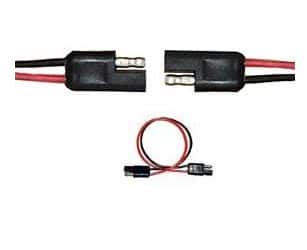
quick disconnectsTwo pin quick disconnect bullet leads are normally used for connections where polarity is critical. The cables come with a 2-pin molded connector. It also has a 2-pin bullet lead for quick disconnect. The cable is 12 inches long and its leads are color-coded. The pins have a positive grip while providing instant connection or disconnection as required.

The cable is made of a 12AWG wire. The bullet type connector is suitable for male to female terminal connections. Suitable locking mating ends are provided so that proper connection is maintained under all conditions. CES produces these cables with the product number of 1376APF09.