Category Archives: Newsworthy

Solar Energy in China: Here Comes the Sun

Growing demand for renewable energy sources has skyrocketed all over the world, but no where is this more evident than in China.

Take a look at the city of Rizhao where miles of dark tubing cover the roofs of apartment buildings and private homes. The reason? Using solar powered hot water heaters is mandatory in Rizhao. In fact, due to requirements such as this one, China has become the largest producer (and consumer of) solar hot-water heaters. Rizhao’s commitment to solar energy is deep: it has pledged to become the very first city in China to become carbon-neutral.

The good news for all of us is that the surge in solar panel requirements has created more supply, and thus lower pricing for all of us. The lower prices help make solar energy more affordable even here in the US.

As new panels are shipped to us, we will be passing on the new lowered prices to our customers. West Florida Components has just lowered our prices on all new solar panels by an average of 16%. Good news for all of us!

Rubber Feet – How to Apply Self-Adhesive Rubber Bumpers

Many customers have asked about the best way to apply self-adhesive rubber feet to surfaces so that they are properly applied…and stay on the intended surfaces.

Here are the recommended application instructions:

    • Clean the surface where you will be applying the rubber feet. It should be dry and free of debris, oils and solvents. In addition, the ideal surface for rubber feet application is smooth and non-porous. You can use a mild solvent such as isopropyl alcohol to remove dirt or grease.
    • Grasp the rubber bumper on the sides without touching the adhesive.
    • Press the rubber bumper firmly into place on the application surface. The rubber foot can not be repositioned without effecting the adhesive.
    • For best results, allow 24 hours before exposing the rubber feet to heavy force or weight. This allows the adhesive on the rubber feet enough time to ‘cure’.

Besides following the above instructions when applying the rubber feet, it is important to keep the rubber feet (both storage and use) at a temperature that is between 70° – 80°F (21° – 27°C).


Choosing Batteries for a Solar Energy System

When putting together a solar energy system, like any other project, having the proper parts and tools for the job is paramount to overall success. With quality components and a little bit of know how, you can design and install your very own solar energy system whether for dedicated appliance use or as a complete replacement for conventional electric energy. Choosing the right parts is a big step in the process, and once you’ve decided which type of solar panels to use and how many you’ll need, the next logical step is to find appropriate batteries.

The most important step in choosing batteries for your solar energy system is making sure you purchase a bank with corresponding voltage to the panel array you’ve designed. The voltage of individual battery units on the market is 2; depending on how many individual battery units come in the bank, the voltage of the unit itself will be 2, 4, 6, 8, and so on. Once you’ve established the correct voltage for your battery bank, you can browse the available types and models to arrive at the perfect unit for your system. There are four basic kinds of battery banks widely available for purchase: marine models, and “industrial strength” varieties which include flooded, gel, and AGM features.

The marine models, commonly used on boats and small vehicles such as golf carts, tend to be the least inexpensive, and may be an option for small solar projects or those requiring solar powering for a limited period of time. In the long run, however, purchasing an industrial battery bank will save money. Flooded battery types are an economical option, with a moderate price and a reasonable longevity. These types release gas while charging, and so are not suitable for indoor use. Gel batteries, while a little more expensive, do not release gas allowing for indoor use, and come with a slightly longer life expectancy. Finally, AGM batteries may cost more, but have numerous benefits, including the longest longevity available, lack of gas or other leakage, and superior efficiency.

Taking care to select the battery bank that’s right for your solar system and its application is an important part of the overall design process, and, if done carefully, can lead to many years of nearly maintenance-free energy enjoyment. Shop with quality in mind and give yourself the gift of peace of mind for years to come.

RGB Tricolor Flashing LEDS – Exciting New Product!

West Florida Components has just started to carry an exciting new product – RGB Tricolor Flashing LEDS!

At first glance you might think “Why are they calling them both RGB AND Tricolor?” The reason is that each LED is actually 3 separate LEDS housed in one case.

They operated in a sequence: first one color is lit at a time, then two light up, then all three. The cycle is completed when all three LEDS have been lit slowly, then begin to flash. Max voltage is around 3V.

We were trying to think of some interesting uses for these LEDS. Certainly they’ll be fun to use around the holidays – in garland or in wreaths or other holiday projects. How about as a centerpiece? They would also be great for costumes and for jewelry making.

Here’s a challenge for our customers:

Use your imagination and find a great project to use these in. We’ll feature the best suggestions/projects in a video on our home page!

A New Vacuum Tube Amp – Flash Quattro!

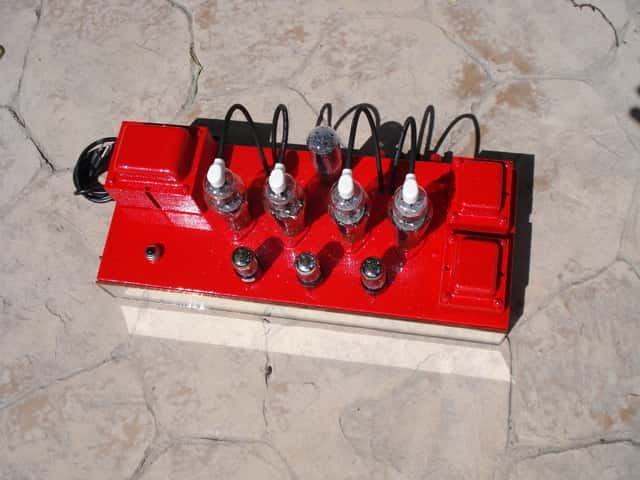
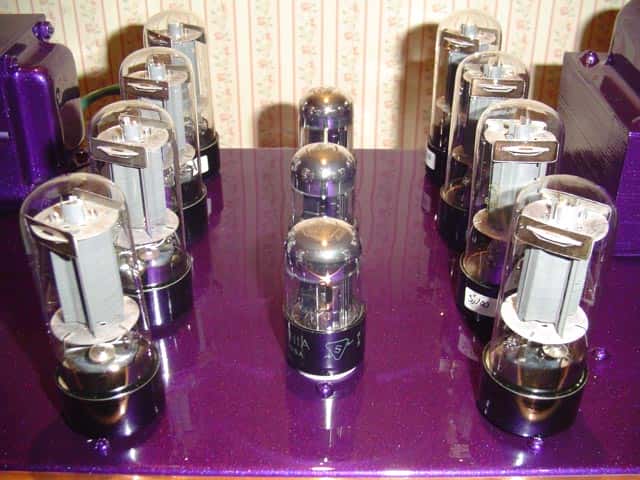
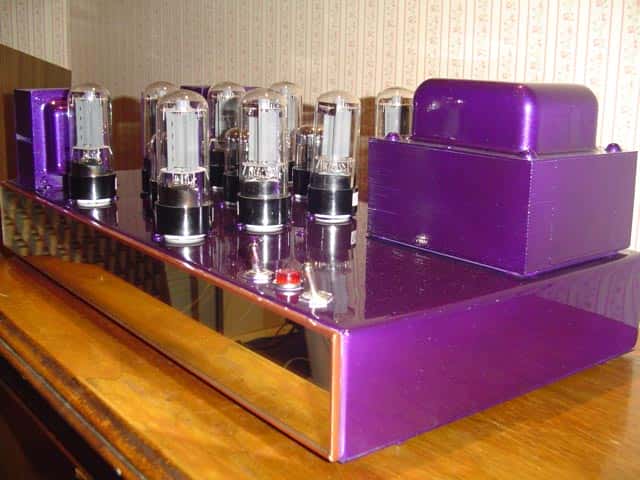
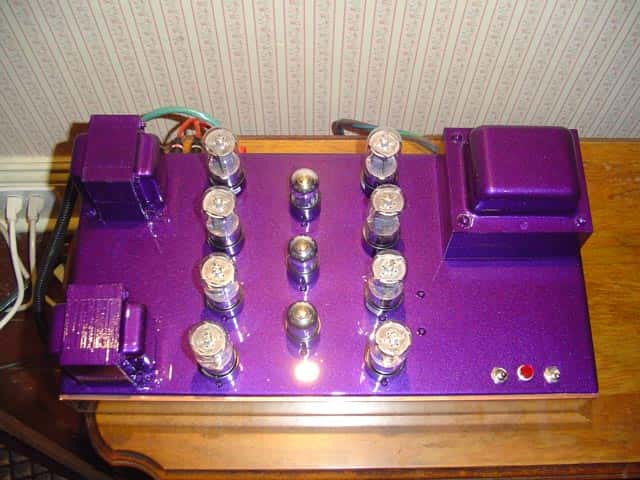
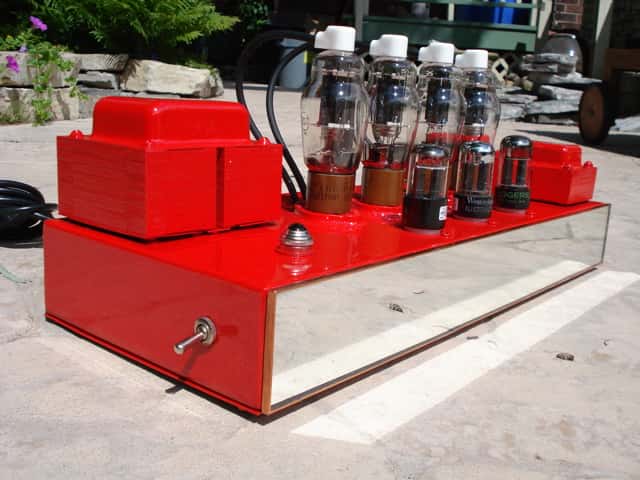
Steve from Canada has just sent us some pictures of his latest creation. This one is fantastic!

Here’s what Steve had to say about it….

Hello everyone, meet Flash-Quattro.  That means “four flashes”.  I
chose the name because the 807 tube is very art deco and it made me
think of the 1930’s series ‘Flash Gordon’,   and there are four of them
hence the name,- simple!

This is the latest version of the ‘Book-shelf’ amp series, like the
Caterpillar and Firecracker amps, this one is long and lean.

Now about the amp, it’s a push-pull 807 putting out 40 watts per channel or so,  in tetrode.  Rectification is with a 5R4, but you can choose to use 5U4
or 5Y3.  All supply the amp with more or less voltage and will change
the personality of the sound a bit.  I like the 5R4 so that’s why it’s
there.  Input tubes are a trio set of 6SN7GTB’s.

The output transformers are those nice Seeburg units that have Ultra-linear taps, but as I mentioned, I connected them in tetrode because I prefer the
sound of tetrode.  These outputs have impedance taps for 1,4,8,16 ohms.  A selector switch on the back of the amp allows you to switch
impedances ‘on-the-fly’ so you can choose and compare the taps you like
for what ever speakers you’re using at that time.  There is no problem
using the 4 ohm tap on an 8 ohm speaker, it how it sounds to you.

The power transformer is a Lowrey unit and a plate voltage of 373 vdc.
Classic green jewel light and side toggle On/Off switch.  Painted by my
good friend Joel Luttrell, and having his signature touch, a flawless
mirage of firecracker red (yes the same red as used in the
‘Fire-Cracker’ amp) and ice-pearl sparkles.  Apparently a fly decided
to do the back-stoke in the final coat of clear, so Joel had to pluck
out the fly, buff, and add more coats of clear.  Knowing Joel, there’s
probably 10 or more coats of clear here!
Take a look…..

vacuum tube amp


vacuum tube amp


vacuum tube amp


As always – thanks for sharing, Steve. We are amazed!

Opening Up and Tearing Down an IPOD Shuffle

Opening up and tearing down an IPOD Shuffle to see what’s inside…

The 3rd Generation of the IPOD Shuffle is a wonder of technology….1000 songs stored in an aluminum case smaller than a disposable lighter.

Did you ever wonder what electronic components make up the guts of an IPOD Shuffle?

You might be surprised at what goes into the circuitry of the IPOD Shuffle. In descending order by percentage of cost, the main components are:

logic, memory, metals, rechargeable materials, connectors, PCB, crystal, misc, capacitors, transistors, analog, diodes, magnetic, and plastics.

Here’s a partial breakdown by number of electronic components:

Capacitors – 65+
Resistors – 50+
Diodes – 4+

Pretty amazing what goes into equipment that measures only 45.2mm x 17.5mm x 7.8mm when fully assembled! This is possible because the components are extremely small surface mount components.

If you look at the cost breakdown by component family, it’s just as revealing. Naturally, the largest share is for memory in the form of IC’s. Over 70% (about $12.00 worth) is for logic and memory.

Grounding Wire in Your Solar Energy System

As they become increasingly popular among both homeowners and businesses, solar energy systems are helping to create a world full with the possibilities of clean, renewable energy.

The efficiency, affordability, and environmentally friendliness of solar panels and accessories are a far cry from the costly, wasteful, and polluting methods of power generation traditionally used to secure energy for the booming population around the world. But this innovative technology is not without its perils, the foremost of which is the danger of electrical shock and related fires. This serious risk is easily mitigated by the practice of grounding a solar energy system. It’s easy, fast, and inexpensive, and in many places, including the United States, it’s required by NEC laws for most systems and applications.

To “ground” a given electrical system means that it is connected to the earth, which provides a shield between the power conductors and a person or separate object. The practice of grounding solar energy systems is important for a variety of reasons. Most modern systems are installed on rooftops and other similarly elevated spaces to achieve maximum sunlight exposure. While this positioning is optimal for efficient solar panel usage, it also exposes systems to electric wiring, antennae and satellite equipment, and telephone and cable systems which can be prone to breakage and hanging, especially in areas that experience turbulent weather. The common positioning also exposes systems to objects such as tree limbs and debris.

These objects, if brought into contact with a non-grounded solar energy system, can contribute to shortages and create a fire risk too dangerous to ignore. In addition to these accidents, non-grounded systems can cause electric shock when touched by humans and animals, especially those systems which carry a high voltage or are in their veteran years of use.

The process of grounding a solar energy system is a basic one; a “ground” or rod is driven into the earth, preferably at a depth of at least a foot or two, and a proper grounding wire is tied to it. This wire is then attached to the solar energy system, completing the barrier. It is important to note that the grounding set ups of AC and DC systems must absolutely be kept separate, and that excess grounding wire can become a hazard all its own.

With the proper length grounding wire, a simple rod, and a careful attention to detail, you can render your solar panel system both safe and reliable while complying with important regulations.

The post above is offered as an opinion. If you are installing a solar energy system, please consult an expert for exact instructions to protect yourself and your property. West Florida Components accepts no liability for you, your property or your solar system.

He’s at it again! New Vacuum Tube Amplifier from Steve

Wow! Congratulations to our customer, Steve White, on his recent interview with the The Peterborough Examiner where Steve talked about his made-from-scratch vacuum tube amplifiers.

Steve sent some pictures of his latest project. He says it’s the biggest and most powerful amp that he’s made to date.

Here a new one. This is the biggest and most powerful amp I’ve made
yet! It’s a Push-Pull-Parallel 6L6 putting out a conservative 80 watts
per channel. I think I’ll keep this one for a while….
It has 8 of your 470 uf 400 volt electrolytic capacitors in it and one
of those small mylar coupling caps also.

Take a look for yourself…..

As always, great work, Steve.

What Happens to Old Electronic Components and Boards?

We came across this blog post the other day and thought it was worth bringing here.

Here’s an excerpt:

Yesterday I had the opportunity to shoot video in a facility that is the largest company in America that recycles the glass from electronics and computers. The men who own this company, built the machines that separate and break up the glass, themselves.

Electronic products and computers are torn apart. The plastics are sold to one vendor while the electronics and circuit boards are sold to another. The glass fragments are then shipped to companies that melt it down and produce new glass.

I was impressed by how much of the material is able to find new life, rather than to be dumped into a landfill where it would simply sit for all time.

I hope that he’ll update his blog when this segment is aired – I’d love to see the whole process!