Posts Tagged ‘Resistors’

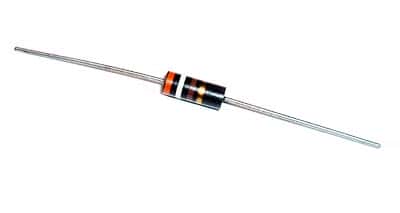
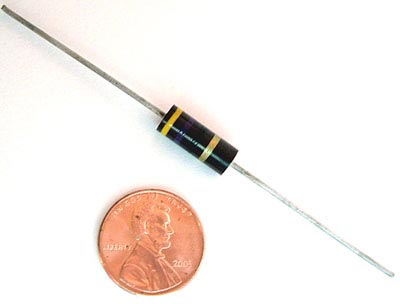
More Allen Bradley carbon comp resistors now available!

Thursday, July 15th, 2010

We’ve updated our resistor inventory and added many more NOS Allen Bradley carbon comp resistors. Between the 1W values and 2W values, we now have over 150 different 1W and 2W carbon comp resistors on hand!

Included in the selection are many Military (MIL-SPEC) Allen Bradley carbon comp resistors. The military resistors typically have a tighter tolerance than the standard resistors.

Allen Bradley carbon comp resistors are valued for their consistency and uniformity. The Allen Bradley corporation reference materials have this to say about their hot molded resistors:

Years of accumulated experience have shown that Allen Bradley hot molded resistors are unequaled for uniformity, predictable for performance, appearance, and freedom from catastrophic failure. Allen Bradley resistors are made by an exclusive hot molding process on automatic machines developed, built, and used only by Allen Bradley. There is such complete uniformity from one resistor to the next, million after million, and long term in-circuit performance can be predicted with usable accuracy. When used according to published ratings and recommendations, Allen Bradley hot molded fixed resistors will not open circuit nor exhibit erratic changes of resistance value. They are probably the most reliable of all electronic components.

We get frequent requests for other values so we were thrilled to get more for our stock! Quantities are limited – especially on the MIL-SPEC resistors.

Application information for Allen Bradley resistors

Tuesday, June 8th, 2010

Allen Bradley resistors are one of the best sellers on the West Florida Components web site with good reason.

The following information has been compiled to aid in the everyday selection and application of Allen-Bradley hot molded resistors. The statements should be helpful in evaluating the use of all types of AB hot molded resistors in broad general terms, and are not to be interpreted to be precise or exact.

A comprehensive list is made of the standard normal resistance values in their available tolerance categories, the rated continuous working voltages for all hot molded types, the part numbers, and color codes – all information provided for all values from 1 ohm to 100M ohm, taking into account the available range of values for each type (as of 1985).

Allen Bradley Resistors

Allen Bradley Resistors

1 – Low value resistors exhibit less change due to humidity, temperature and voltage than high value resistors.

2 – Resistance changes due to increase in moisture content are always positive.

3 – Resistance changes due to humidity are temporary, and, in the case of Allen Bradley resistors, are reversible.

4 – Change of resistance which has occurred due to humidity may be essentially eliminated by conditioning the resistor at 100°C or by dry storage.

5 – The effects of humidity may be minimized by operating the resistor with as little as 1/10 rated wattage load.

6 – Resistance change due to load life is permanent and usually ultimately negative.

7 – Resistance change due to load life can be minimized 1% – 2% in many thousands of hours by 50% derating period. The same result can be attained by limiting the maximum operation surface temperature of the resistor underload to 100°C. Permanent resistance changes as a result of storage of temperatures below 100°C are negligible, even for extended time periods.

8 – Resistance change due to soldering is positive and may be permanent if the resistor has excessive moisture present in its body. It can be greatly minimized if resistors are dry at the time of soldering.

9 – The temperature characteristics of Allen Bradley resistors is positive above +80 and below -10.

10 – The temperature characteristics of Allen Bradley resistors is negligible from -10°C to +80°C.

11 – The voltage characteristic (negative) and the temperature characteristic (positive) of Allen Bradley resistors tend to cancel one another in an Allen Bradley resistor in an average operating conditions, where both significant voltage and elevated temperature are present.

12- The heat sink to which a resistor is connected affects its rating. Resistors operated in multiple should be derated unless adequate heatsinks are provided.

13 – The quality and reliability of Allen Bradley resistors is the same for, and independent of, any resistance tolerances shown on the resistor.

14 – Years of accumulated experience have shown that Allen Bradley hot molded resistors are unequaled for uniformity, predictable for performance, appearance, and freedom from catastrophic failure. Allen Bradley resistors are made by an exclusive hot molding process on automatic machines developed, built, and used only by Allen Bradley. There is such complete uniformity from one resistor to the next, million after million, and long term in-circuit performance can be predicted with usable accuracy. When used according to published ratings and recommendations, Allen Bradley hot molded fixed resistors will not open circuit nor exhibit erratic changes of resistance value. They are probably the most reliable of all electronic components.

This information was taken in part from the Allen-Bradley corporation reference book dated 1985.

Opening Up and Tearing Down an IPOD Shuffle

Tuesday, June 30th, 2009

Opening up and tearing down an IPOD Shuffle to see what’s inside…

IPOD Shuffle 3rd Gen

The 3rd Generation of the IPOD Shuffle is a wonder of technology….1000 songs stored in an aluminum case smaller than a disposable lighter.

Did you ever wonder what electronic components make up the guts of an IPOD Shuffle?

You might be surprised at what goes into the circuitry of the IPOD Shuffle. In descending order by percentage of cost, the main components are:

logic, memory, metals, rechargeable materials, connectors, PCB, crystal, misc, capacitors, transistors, analog, diodes, magnetic, and plastics.

Here’s a partial breakdown by number of electronic components:

Capacitors – 65+
Resistors – 50+
Diodes – 4+

IPOD guts

Pretty amazing what goes into equipment that measures only 45.2mm x 17.5mm x 7.8mm when fully assembled! This is possible because the components are extremely small surface mount components.

If you look at the cost breakdown by component family, it’s just as revealing. Naturally, the largest share is for memory in the form of IC’s. Over 70% (about $12.00 worth) is for logic and memory.

breakdown of components by cost

Resistor Color Codes – How to calculate resistance

Tuesday, April 14th, 2009

Resistors are marked by color codes to signify the resistance. Discovering how to read and decipher the color codes are a beginning step in learning about electronics.

If you can name the colors of the rainbow, or the color spectrum, in order, then you’re halfway there.

Resistors In Series

Tuesday, September 30th, 2008

Electronic components used in electronic circuits to regulate and limit the flow of electric current in the circuit are known as Resistors. Resistors can be connected in two basic configurations – in series and in parallel.

When connected in a series connection, the resistors are connected in a line. The current flows through the resistors one after the other.

When the resistors are connected in such a configuration, they exhibit the following properties:

The current flowing through each of the resistors is the same, that is, I total = I1 + I2 + I3…and so on. This is due to the fact that there is only one path for the current to flow through. The second property that they exhibit is that the total voltage drop across all the resistors connected in series is equal to the sum of the individual voltages of the resistors, that is, V total = V1 + V2 + V3…

Now since, V = IR, so, V total = I R equiv, which comes down to,
I R equiv = I1.R1 + I2.R2 + …, and since I1 = I2 = I3 .., we have
I. R equiv = I. (R1 + R2 + R3..), or R equiv = R1 + R2 + R3..

So the equivalent resistance of these electronic components connected in series is the sum of the individual resistances.

Resistors in series are often used for obtaining specific higher resistance values which are otherwise not available. They are also used in voltage divider circuits. A common application is in household wiring.

Understanding Resistor Values

Friday, September 5th, 2008

Resistors are available in a wide range of values, but if you observe carefully you will realize that certain values of these electronic components like 15k ohm and 33k ohm are easily available where as some values like 20k ohm and 40k ohm are hard to find. Let’s try and understand the logical reason behind this.

Take a hypothetical situation, where you make resistors every 10 ohm, thus giving you 10 ohm, 20 ohm, 30 ohm, etc. But once you reach the value of 1000 ohm, a difference of 10 ohm would hardly be noticeable as it is a very small value in comparison and making 1000 ohm, 1010 ohm, 1020 ohm and so on, would prove to be futile. In fact making such accurate resistors might prove to be very difficult.

Resistor

Resistor

Thus a acceptable range for these electronic components is one in which the (amount of the) step increases with the value. This is the logic that the resistor values are based upon, and they form a series following the exact pattern for every (multiple of) 10. There are two such series based on the above logic – the E6 series and the E12 series.

E6 series: Has six values per every multiple of ten with 20% tolerance. So the series goes like:10 ohm, 15 ohm, 22 ohm, 33 ohm, 47 ohm and so on, continuing to 100 ohm ,150 ohm, 220 ohm, 330 ohm with each step size (to the higher value) being higher than the last step size, and approximately half of the value.

E12 series: Has twelve values per every multiple of ten (10% tolerance). So the series goes like:10 ohm, 12 ohm, 15 ohm, 18 ohm, 22 ohm, 33 ohm, 39 ohm and so on, continuing to 100 ohm, 120 ohm, 150 ohm etc, thus it is nothing but the E6 series with an additional value in each gap.

E12 series is in common use for resistors and lets you choose values with 10% error margin, and proves to be accurate enough for most projects.