Category Archives: Newsworthy

Keeping up with the newest smartphones

Buy a smartphone in May, chances are that you can buy a bigger – better – upgraded – faster – prettier – cooler phone in June. It’s been that way for years with PCs and notebook computers so why should the smartphone market be any different?

I’m still waiting on my backordered HTC Incredible, but we already have 3 of them in service on our plan.They’ve quickly become the all-time favorite phone at West Florida Components. Powered by a 1GHz processor, these phones are fast! Other favorite features are the 8MP camera, the GPS and the large touch screen. We’re already watching and waiting to see what other gee-whiz features will be added on to this Android-based phone in V2 but we all agree the single biggest improvement they could make to this phone would be an improved battery. Then we won’t have to close down unused apps to preserve battery life.

One thing is for sure: by the time my backordered HTC Incredible finally arrives, the next ‘gotta-have-it’ phone will already be available. That gives me another 2 years to figure out which phone I just have to have next!

Application information for Allen Bradley resistors

Allen Bradley resistors are one of the best sellers on the West Florida Components web site with good reason.

The following information has been compiled to aid in the everyday selection and application of Allen-Bradley hot molded resistors. The statements should be helpful in evaluating the use of all types of AB hot molded resistors in broad general terms, and are not to be interpreted to be precise or exact.

A comprehensive list is made of the standard normal resistance values in their available tolerance categories, the rated continuous working voltages for all hot molded types, the part numbers, and color codes – all information provided for all values from 1 ohm to 100M ohm, taking into account the available range of values for each type (as of 1985).
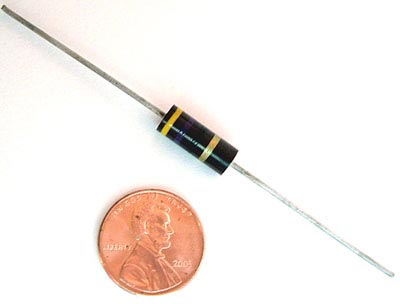
Allen Bradley Resistors

Allen Bradley Resistors

1 – Low value resistors exhibit less change due to humidity, temperature and voltage than high value resistors.

2 – Resistance changes due to increase in moisture content are always positive.

3 – Resistance changes due to humidity are temporary, and, in the case of Allen Bradley resistors, are reversible.

4 – Change of resistance which has occurred due to humidity may be essentially eliminated by conditioning the resistor at 100°C or by dry storage.

5 – The effects of humidity may be minimized by operating the resistor with as little as 1/10 rated wattage load.

6 – Resistance change due to load life is permanent and usually ultimately negative.

7 – Resistance change due to load life can be minimized 1% – 2% in many thousands of hours by 50% derating period. The same result can be attained by limiting the maximum operation surface temperature of the resistor underload to 100°C. Permanent resistance changes as a result of storage of temperatures below 100°C are negligible, even for extended time periods.

8 – Resistance change due to soldering is positive and may be permanent if the resistor has excessive moisture present in its body. It can be greatly minimized if resistors are dry at the time of soldering.

9 – The temperature characteristics of Allen Bradley resistors is positive above +80 and below -10.

10 – The temperature characteristics of Allen Bradley resistors is negligible from -10°C to +80°C.

11 – The voltage characteristic (negative) and the temperature characteristic (positive) of Allen Bradley resistors tend to cancel one another in an Allen Bradley resistor in an average operating conditions, where both significant voltage and elevated temperature are present.

12- The heat sink to which a resistor is connected affects its rating. Resistors operated in multiple should be derated unless adequate heatsinks are provided.

13 – The quality and reliability of Allen Bradley resistors is the same for, and independent of, any resistance tolerances shown on the resistor.

14 – Years of accumulated experience have shown that Allen Bradley hot molded resistors are unequaled for uniformity, predictable for performance, appearance, and freedom from catastrophic failure. Allen Bradley resistors are made by an exclusive hot molding process on automatic machines developed, built, and used only by Allen Bradley. There is such complete uniformity from one resistor to the next, million after million, and long term in-circuit performance can be predicted with usable accuracy. When used according to published ratings and recommendations, Allen Bradley hot molded fixed resistors will not open circuit nor exhibit erratic changes of resistance value. They are probably the most reliable of all electronic components.

This information was taken in part from the Allen-Bradley corporation reference book dated 1985.

Make a coin battery – great electronics project for kids!

What better way to illustrate how to build a basic electronic connection than to use coins to build a battery?

Here’s what you need:

Quarter

Quarter

quarters or dimes
aluminum foil
blotter paper (see below)
salt
cider vinegar
wire (short length of both black and red wire – ~16 gauge)
1 LED (any through hole LED)
scissors
pen or marker
voltmeter (optional)

~~~~~~~~~~~~~~~~~~~~~~~~~~~~~~~

Trace the coins on the aluminum foil and blotter paper. Cut out 10 of each so that you have 10 circles of aluminum foil and 10 circles of blotter paper.

(Blotter paper can be found in the art store or the art section of your local craft store. You can also find blotter paper in the cosmetics department. If you can’t locate blotter paper, then you can also try using thick paper towels.)

Mix a small amount (1/4 cup) of vinegar with some salt. Stir the salt until dissolved. If the salt can not dissolve, then you’ve added too much. Add some additional vinegar and stir. Soak the circles of blotter paper in the vinegar and salt mixture.

Stack the foil, blotter paper and coins as shown in the video. It is important that the foil not touch the other layers. Let the ‘battery’ stand for about 15 minutes to develop a charge.

Connect each lead of the LED to a short piece of wire; the black wire connects to the negative lead and the red wire is attached to the positive lead on the LED. Place the exposed end of negative wire on the bottom of the ‘battery’ touching the foil, and the end of the positive wire to the quarter on top of the stack.

Optional: Use the voltmeter to measure how many volts are generated by the battery. A battery with 6 or more cells should be able to light up a standard LED with no problem!

OPA111BM and other hard to find parts

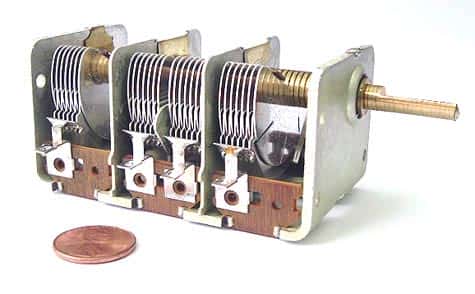
“I was so happy to find that you had Burr Brown OPA111BM in stock!” or “I’ve been looking for that Air Variable Capacitor for months! Can you get more of them?” We get these comments a lot from our customers.Air Variable Capacitors

West Florida Components started out selling surplus electronics before selling both obsolete and new-from-factory parts, and we made a name for ourselves by sourcing hard to get and out of production parts.

Over the years, we’ve kept looking for the surplus parts because our customers need them. Do you have a part that you can’t locate? Send us the part number and we’ll put it on our list of parts we’re actively looking for. We have an extensive list of suppliers and will be happy to look for you.

Converting dimensions from fractions to metric to decimal

We Americans are so used to seeing decimals or fractions for measurements that it’s not been easy for us to adapt to the metric system. Unfortunately, the industry standard sizes of most electronic components are provided in datasheets and descriptions as metric equivalents.

Need to convert a fraction or decimal to the metric system easily? Here is a decimal to fraction to millimeter conversion chart that will make that task easy for you. If you want to convert a number more precisely, use this link to jump to an online metric conversion calculator.

Of course, you can just use standard fractions, but it’s hard to find a T1 3/4 LED when you’re looking for it as a 0.19685 inches LED.

Screw-on rubber feet – newly expanded product line!

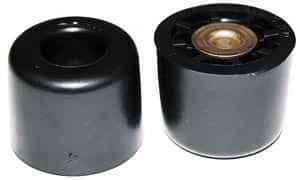
recessed bumpersWe’re listening! You requested a bigger selection, we got them! West Florida Components has now expanded their line of recessed bumpers. Recessed bumpers are also known as screw-on rubber feet and cabinet feet.

The rubber feet can be used in a variety of applications from electronic equipment to woodworking or carpentry and furniture. Where ever you require a rubber foot with a screw, these new rubber feet can be used. Check the specs on each foot for the sizes, recommended screw size and weight rating for each foot.

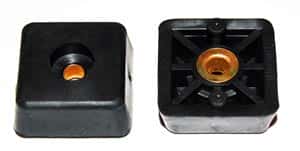
West Florida Components now carries 11 different sizes and shapes – including the popular square feet and the traditional round feet. Both shapes accept different screw sizes and rivets because of the plated steel support bushings included in the recessed area of each foot.

All the cabinet feet are manufactured from thermoplastic rubber which provides excellent shock absorbingsquare cabinet feet qualities and traction as well as being a non-marking material. Thermoplastic rubber is traditionally molded from Monsanto Santoprene®. Santoprene® is a thermoplastic rubber designed to offer chemical resistance equivalent to neoprene and is resistant to a wide variety of solvents and chemicals.

10 Things Your iPhone Can Remote Control

Among the estimated 50,000 iPhone apps, you can find quite a few that make your life easier by functioning as a remote control. After looking at many, we found that these were the 10 coolest things (mostly electronic) that you can remote control with your iPhone.

  • Using the Pocket BLU app, you can control your Blu-Ray Discs for playback, pausing, etc
  • With a Keynote remote and the iWork suite, you can remote control your presentations
  • For $2.99, you can buy a PhotoKeys Photoshop app which gets the Photoshop toolbar on your iPhone
  • The free Apple Remote app will allow you to remote control your iTunes Jukebox
  • Air Mouse Pro lets you convert your iPhone into a wireless trackpad and keyboard
  • Some DVRS like the ones from DirecTV, DISH Network and Comcast can be controlled with an iPhone app

  • Use the Zipcar app to book a rental car – then you can use your iPhone to make the horn beep or unlock the car
  • An app for Schlage LiNK allows you to use your iPhone to lock, unlock your doors, turn lights on, turn your security system on or off, etc
  • The L5 remote add-on will convert your iPhone into a universal remote control
  • iCarly fan? Get the “Sam’s Remote” app which turns your iPhone into the iCarly remote – complete with sound
  • The best app for the iPhone? How about “The Boyfriend Remote”…Increase his income, make him take you shoe shopping. Possibilities are endless.
How to Make Your Own LEDS? Whooooooooa

I found this how-to today on the great Popular Science web site.

Now that I’ve read through the article – I am amazed that I’ve never seen these instructions written up before.

Theodore Gray, who authors their popular “Gray Matter” column, gives the full scoop on the basic materials used to construct LEDS and provides the basic instructions needed to see just how LEDS work.

OK, it is not so easy to find some synthetic silicon carbide (carborundum) laying around, but surely everyone could get their hands on some sandpaper, needles, a 9V battery and a snap. Follow his instructions, and VOILA…you’ve recreated the basic principles behind the creation of LEDS.

West Florida Components is Social!

Are you doing the whole Facebook thing? How about Twitter?

Well, we are….and we’re also on StumbleUpon, Digg, Delicious and a whole bunch more.

Why should you care? Because we give away a lot of discounts to our Facebook Fans and Twitter Followers! And our Facebook Fans and Twitter Followers are the first to know about newly discounted electronic components, parts and supplies.

We never overload our customers with too much communication but we like to keep in touch. The social media sites have given us a wonderful platform to connect with our customers.

Facebook

Facebook

So the next time your on Facebook, don’t forget to add our Fan Page to your list….we’re the same name over there as we are here: WestFloridaComponents (no spaces):
West Florida Components on Facebook

And here’s our Twitter user ID: westfloridacomp (had to be shortened because of their site):
West Florida Components on Twitter

So next time you feel like socializing, come on over and introduce yourself! We’d be thrilled to meet you.

Tantalum Capacitor Industry Needs New Resources

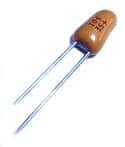
Tantalum Capacitor

Tantalum Capacitor

As the demand for tantalum has recorded 5% growth every year, the supply of tantalite has decreased setting up the electronic components industry with a possible shortage.

Tantalite, which is the key component of tantalum used to make tantalum capacitors, is mined primarily in three countries: Australia, Mozambique and Canada. Companies in those countries reduced or suspended production as the economy tanked in 2008 and consumer spending fell.

Recently, most production of tantalum has been taking place in Brazil and Africa but with the previous production facilities not producing the tantalum, a shortage through 2012 is possible.

What does that mean to consumers and companies that need tantalum capacitors?

Increased demand will push prices higher on current stock….and if current supplies are depleted, a shortage like the one that occurred in 2000 may occur pushing up prices even further.

Tantalum capacitors have grown in popularity for many reasons. To start with, tantalum capacitors have a larger volumetric efficiency when compared  to other types of capacitors. To illustrate this point, a 10uF tantalum can be used in place of a 100uF aluminum capacitor.

In addition, tantalum capacitors are able to be inserted on circuit boards easily. When you couple this with the tantalum capacitor’s greater  power dissipation characteristics when looking at other capacitors in this size range, tantalum capacitors  can be inserted in small spaces. This makes them good candidates for tightly designed boards. You will often find tantalum capacitors used in laptops, computers, cellular phones, auto circuits and other similarly sized electronic devices.

Another outstanding characteristic of tantalum capacitors is their nearly unrivaled life span. The shelf life of tantalum capacitors is unparalleled when looking at other capacitor types such as those made from electrolytic material since the performance qualities stay intact over time and they should not lose capacitance like many other popular capacitors.